Wednesday, September 13, 2006

Cavorting in the Elysian Fields


Warning: do not let your 3 year old read this, as the material is suitable for a slightly more mature audience, of the age that might safely watch Shrek without getting grossed out by the opening scene. My 9 and 13 year old nephews are certainly ready for what follows (cuz I watched Shrek with them, and all three of us split our guts open laughing through the whole thing). Of course, many adults got grossed out by the opening scene, so maybe only 9 to 13 year olds should be reading this.

Classical Greek mythology is a big hit with the French. Napoleon considered himself to be the true descendant of Julius Caesar (but then so did the German Kaiser and the Russian Czar, both of whose titles come from the word Caesar), and much earlier than that, during the Renaissance, French scholars, artists, and writers pretty much threw aside the religious themes of the Middle Ages and rediscovered the Greek myths. French museums are full of art depicting Heracles (Hercules to us), Zeus, Diana, themes from the Odessey and the Iliad, Theseus, and Paris. Oh yes, Paris--he's the one that started the Greek-Trojan war when he stole Helen of Troy--who was actually not from Troy at all, but fell in love with Paris, a Trojan, and left her Greek husband to run away to Troy, thus being the "face that launched a thousand [Greek] ships. And you thought is was Jackie O. all this time!

Greek mythology is pretty blunt and straightforward as far as descriptions of violence, romance, and deception are concerned. They certainly wouldn't make our G pr PG ratings, Disney animations notwithstanding. The Greek playwrights of the 5th century BC perfected the idea of "catharsis," in which a tragedy of such epic proportions is visited upon the protagonist that, when viewed in comparison with one's own paltry problems, one could leave the theater feeling positively good about oneself.

The house of Atreus was condemned all the way from his Grandfather Tantalus, through his father Pelops, and until his son, Agamemnon, was murdered by his wife Clytemnestra, the sister of Helen. Sounds complicated? It gets worse: first comes Tantalus, who stole ambrosia from the gods and also revealed secrets of the gods to men. To compound matters, he invited the gods to feast at his table, and just for fun took his son Pelops, killed him, cut him up, cooked him, and served him up to the gods. Being somewhat sharp, they were on to his joke right away, and put the pieces back together and brought Pelops back to life (obviously, because he grew up and had bad kids like Atreus).

The gods decided that Tantalus' punishment would consist of an eternity standing in knee-deep water, cool and tasty, with pears hanging within reach from a tree branch above his head. Not a bad punishment, except that whenever he bent down to scoop some water to slake his thirst, the pool suddenly drained dry; whenever he reached for a succulent pear to satisfy his extreme hunger, a breeze came to blow the bough out of reach. Thus comes our word "tantalizing."

Pelops and his son Atreus' sins are too complicated and too onerous to enumerate, but suffice it so say that they both suffered and died appropriately for their indiscretions. Agamemnon seemed better: he organized thousands of Greek warriors to sail to Troy, destroy it, and bring Helen back to his brother Menelaus. Angry at the calm weather that delayed their sailing for many months, he decided to sacrifice his daughter Iphigeneia to appease the gods. It worked, and the Greeks sailed to Troy, fought for 10 years to try to take the city, and finally wheeled the Trojan horse to the gates of the city and snuck away to wait. Sure enough, the Trojans were happy to see the Greeks gone, and wheeled the huge horse into the city. Little did they know the horse was filled with Greek soldiers armed to the teeth, and when the sun set, they snuck out and burned the city to the ground, ending the Trojan war.

Agamemnon was one of the few to make it back to his home (some of the gods had been cheering for the Trojans, and made sport of sinking all the Greek ships in new and different ways). Unfortunately for Agamemnon, 10 years away from home was too much for his wife Clytemnestra, especially when she found out that he had killed one of their daughters for good luck. He barely got home, shouted, "I'm home honey!" and she ran him through with a sword. The boyfriend was waiting in the shadows to make sure she got the deed done. If memory serves me right, this ended the curse of the house of Atreus, although I'm quite sure Clytemnestra got hers as well. The Greek gods were not ones to let a good opportunity for revenge to go by.

All that to say that one of the biggest boulevards in Paris is called the Champs-Elysees, or the Elysian Fields, the place where the gods cavorted, and where, if you were a really good mortal, you too could run around, eating ambrosia and doing whatever else one can do in the Greek concept of heaven.

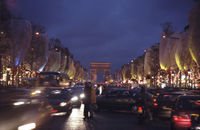
That's where the comparisons with modern-day France ends. The Champs-Elysees is, in reality, a wide boulevard that goes from the Tulleries gardens, winds in a giant traffic circle around the Arc du Triomphe, and crosses the Seine to the northwest into La Defense, a large suburb of Paris that is a huge business hub.

So, instead of being an idyllic heavenly field of pleasure, the "Elysian Fields" in Paris is actually a deathtrap of speeding buses, taxis, businessmen late for work, and hordes of little scooters weaving in and out in an effort to make some progress. Anyone brave enough to sally forth into the road is either as strong a Hercules, as clever as Odesseus (Ulysses), or as unlucky as Atreus.

Fortunately, we had a guide (sort of like Dante's Virgil who guided him through the circles of hell). Our French teacher, Marguerite, fresh from an altercation on her bike (a car slammed on its brakes in front of her and she ran into the back of it, unhurt), helped us get from the Grand Palais to the Tuileries where we held our lesson. I saw no signs of ambrosia, but we had a tasty chocolate crepe in the park. I guess I'll leave the Greek gods to Homer, and try to avoid getting flattened by any modern-day Cyclops (aka tour buses)...

Tuesday, September 12, 2006

Aujourd'hui: rien


Note to self: don't write the above entry into your daily journal if you are king of France, living sumptuously in the gigantic Palace of Versailles. Especially if your foreign wife, when told that the masses of poor in Paris have no bread, answers, "let them eat cake."

That entry ("today: nothing") is what King Louis XVI wrote in his personal journal on July 14, 1789, an apparently inauspicious day in Versailles, a world away from Paris. In Paris itself, the masses were storming the Bastille, setting in motion the French Revolution that destroyed the monarchy, decimated the nobility, set the stage for Napoleon's rise, and caused the foolish king and his out-of-touch queen to lose their heads to the guillotine. July 14 is celebrated in France as Bastille Day, their biggest holiday and the kick-off to their summer vacation season, which ended last week with the rentree, or re-entry.

What with yesterday's big march around the Louvre, and a French lesson with Marguerite again, we were exhausted last night. Once again, as we walked back from the Louvre, I was sure that someone had moved our hotel several miles further to the east. This morning we slept in and lounged around the hotel, then went out into the Marais to check it out one more time before we re-locate to the St. Germain des Pres neighborhood on Thursday.

As I mentioned before, Beth caught a cold the other day, and now has developed a nasty dry cough. Not nasty because I think something terrible is going to happen to her, but nasty because I'm a light sleeper already, and several night-time coughing jags kept me awake. I don't think Beth even woke up for most of them. It doesn't seem fair.

What is fair is that here in France, you can waltz into a pharmacy, talk directly to the pharmacist, and get a lot of medications that would require a prescription in the States. I know I'm cutting my own throat here, but this is a very convenient thing. Since I mostly do surgery and take care of surgical patients, I wouldn't really lose my job if everyone in the States could sidle up to a pharmacist and ask for some Amoxicillin or cough syrup with codeine. For 10 euros ($12.50), we got 8 oz. of generic robitussin AC and some Tessalon Perles. Not bad for a semi-socialist country.

While poking around the Marais, we popped into an interesting shop where the proprietor has a beautiful pool (about the size of an average dinner table around) with large goldfish and shubunkins in it. The fish are 6-8 inches long, almost a big as the ones we have in our outdoor pond and fountain. It was fun to see the fish, and to talk to the proprietor who clearly took pride in his special feature.

As I talked with him about our shared interest in goldfish and fountains, it struck me: I'm having a real conversation with a real live French-speaking person without using any English, and he actually understands me! It was gratifying, and to my great pleasure, he told me that he thought my French was quite good. He actually said it twice, and looked like he meant it. He then proceeded to tell me that most Americans burst into his store and immediately blurt something out in English, assuming that everyone everywhere speaks English and wants to speak English.

I told him that, whenever we visit a country whose language is other than English, I try to learn at least the simple polite phrases to honor their language and culture. It's my little way of bridge-building. With so many nuts and hotheads out there trying to divide and destroy, I figure I can make a little effort to reach across the language and culture barriers and find some common ground. Besides, when I ask for it in French, I think the waiter cuts me a bigger piece of tarte au pommes, and that ain't bad at all. Try it.

Curmudgeon's corner: what with all this reaching across barriers and all, there is one barrier that France could do with a lot more of: a real, bona fide non-smoking section at restaurants. Oh, the law says that every cafe, bistro, and restaurant has to have a designated non-smoking area, but that particular law is clearly enforced by Inspector Clouseau. Friends who have made the mistake of asking for a non-smoking table have been shunted over by the bathroom or near the kitchen by the big swinging door, and then summarily ignored by the waiter as a punishment for asking to be excused from fumigation.

Tonight we ate at one of our very favorite Parisian restaurants, C'Amelot, near the Bastille on rue Amelot (thus the camelot pun). It is a great restaurant, with a new menu every week based on what the chef feels is most fresh and appealing from the market. You could go week after week (I wish) and never see the same dish on the menu. This is very bad for my friend who shall remain unnamed but who always orders exactly the same item (3-cheese cheeseburger) every time we eat at a certain restaurant. But this is very good for me, because I love trying something new almost every time I go out to eat.

Anyway, back to the Curmudgeon's Corner (it's really hard for me to stay annoyed here in Paris): Beth smelled cigarette smoke (she can smell it blocks away), and we began to look around to see who was smoking. Imagine our surprise (and dismay) when we realized it was the chef, puffing away in the kitchen like a smokestack. But then the soup and tempura came, and all was forgiven. By the time the chocolate volcano and rice pudding with caramel sauce came, I would have flicked my bic for him if he'd asked (after I lectured him on the dangers of smoking of course).

Seriously, though, smoking is a much more public nuisance than in the States, and it is my impression that more young women and the same number of young men smoke here compared with the States. Women especially are reluctant to quit because they know they'll gain weight, and obesity is tolerated much less here than back home. I guess there's always a price to pay, but in the long run, being a little "enrobed" and smoke-free is healthier than smoking and staying thin.

Tomorrow: the Elysian Fields and Grand Palais...

Monday, September 11, 2006

Cracking the Da Vinci Code


We finally tackled the Louvre Museum today. Wow, what an incredible collection of art, artifacts, and second empire decorating! I almost died of gold poisoning from all the gilded lamps, walls, picture frames, ceilings, and bricabrac. When we left our hotel, we told Phillip where we were going, and he said, "see you tomorrow, or maybe the next day." It's true, you could spend several days just to walk slowly through all the galleries, let alone actually look at the works of art. It's almost as big as the Megamall. Seriously, there is an incredible array of art and antiquities on display here, and we only walked through about a quarter of the galleries in the 7 hours we were there.

We started the day meeting Mary, a guide from Paris Muse, a museum tour company that comes highly recommended. They take only 4 people per tour guide, unlike the hoards of other tourists following a single guide that we saw with other groups. Actually, we were the only 2 in our group, so it was basically a private tour.

Here in brief was our itinerary:
The Code of the Hammurabi, Babylon, 1792 BC (first written laws in history; one of them says--no lie--that if a surgeon operates on you, you have to pay him for his work, so there)
Palace of Khorsabad, Assyria, 721 BC (the guys who captured Israel's northern 10 tribes)
Palace of Darius I of Persia, 500 BC (the guy that Daniel dealt with)
Neolithic Statue from Jordan, c. 7,000 BC (oldest piece in the museum)
Walls of the original medieval Louvre castle, including moat and dungeon, 1180 AD
Statue of Diana from 100s AD
Venus de Milo 100 BC, statue, one of the big 3 together with Nike and Mona Lisa
Winged Victory (Nike) of Samothrace, 190 BC, statue #2 of the big 3
Apollo gallery (death by gold leaf and royal excesses; the crown jewels of France are here)
Botticelli, Venus and the Graces... 1483 painting
Cimabue, Virgin and Child, 1280 painting in a very Byzantine style
Lippi, another virgin and child painting, 1437 in a much more life-like style
Ghirlandaio, Portrait of an old man, 1490
Leonardo, (Da Vinci is where he was from) another virgin and child, 1508, to set us up for:
Leonardo, Mona Lisa, 1506 (the last and most crowded of the big 3)
Veronese, Wedding at Cana painting, 1672
Raphael, Portrait of Castiglione painting, 1514
Caravaggio, Fortune Teller painting, 1610
Michelangelo, 2 Slaves, marble statues, 1513

There you have it, folks: 2.5 hours of fun in the Louvre. Mary was extremely helpful and insightful throughout the tour, pointing out interesting "little known facts" and picking the best pieces to understand a particular painting style, like Leonardo's use of sfumato, or "smokiness" to blur the background and shading around Mona Lisa's face and torso, so she appears to be always facing you, whether you are looking from the right side of the gallery or the left. We tried this, and sure enough, she actually appears to turn her head and shoulders toward whichever side you are standing. It's freaky.

If you come to Paris, and if you want to give the Louvre a shot, spend the money and pay a good tour guide to take you to see the treasures of the Louvre collection. Mary is a PhD candidate in architecture studying at the Sorbonne, Paris' most prestigious university, so we got a lot of good info in a very short time from a very reliable source. After she left us, we visited the Cafe Marly, one of 4 or 5 restaurants inside the Louvre, and had lunch. Then we spent the afternoon in the Richelieu wing, which houses the non-French painters, especially the Dutch, Flemish, and German schools. Beth especially likes the tiny Flemish portraits and family scenes from the 1600s.

I saw a desk at the entrance where you could rent an audio guide (a headset and a sort of built-in MP3 player) for various parts of the museum. One of the most popular was the Da Vinci Code guide, which takes you to all the areas of the Louvre that the book and film describe. Caveat Emptor: If you read the Da Vinci Code by Dan Brown, loved it, and believe his conspiracy theory whole-heartedly, don't read any more of this post, or at least don't send me any unsigned hate mail. If you are one of the 10 English-speakers in the world who haven't read the book but still plan to, don't read this (I'll give away the ending). All others, allez-y (read away).

Opinions about this book vary widely, but fall into basically three categories: those who love it and believe the conspiracy theory, or at least seriously question the motives of the religious establishment; those who hate it out of principle and usually haven't read it; and those who liked the thriller aspect but doubt the basic premise of the book. I am of the latter category, having read the book last February while on vacation in Nevada. The entire book was one long chase scene broken up every few pages by a soliliquy or diatribe by one of the 3 principal characters about a secret conspiracy.

The synopsis is this: an American professor of "symbology" is in Paris to give a lecture. While he is there, the curator of the Louvre is murdered in one of the galleries, but lives long enough to leave arcane clues on various paintings that lead the professor and a beautiful French police cryptologist on a daring mission to uncover a deep, dark secret: that Jesus really didn't die on the cross, but married Mary Magdalene, had children by her, their family blood line continues to this day, and it actually includes the beautiful young French police cryptologist.

OK, a lot more happens in the book (I haven't seen the movie, although Audrey Tautou, who played Amelie in that movie and plays Sophie Neveu in this one, is one of my favorite actresses), but let's leave it at that for my purposes. The point of the book seems to be to raise a conspiracy theory to cast doubt on the historical and theological record as we have received it. He attempts to build a case that:

  1. The 4 gospels (Matthew, Mark, Luke, and John) were chosen by Emperor Constantine at the Council of Nicea in the 300s AD, essentially to promote the idea of Jesus' divinity for the first time. This, as the conspiracy theory goes, would bolster Constantine's political strength and keep him in power, with Jesus as his sort of divine mascot.
  2. Many of the rejected "gospels" like the gospel of Mary and the gospel of Peter (Brown claims that there are more than 80 competing gospels, all equally valid), portrayed Jesus as completely human, not divine at all, and therefore just like the rest of us, wanting a wife and children.
  3. Jesus had a special relationship with Mary Magdalene that went far beyond a teacher and pupil relationship, and ultimately led to a marital one that produced children.
  4. Somehow this would elevate Mary Magdalene to divine status, affirming the "divine feminine" and opening up goddess worship as the best and highest form of divine worship.
  5. The secret of Jesus and Mary's family and bloodline has been scrupulously protected and preserved, along with the bones and relics of Mary, by many secret groups, including the Knights Templar during the middle ages, and the Masons and the "Priory of Sion" since then.
  6. The "Priory of Sion" is said to include many famous people including Leonardo Da Vinci (thus the book title) and Sir Isaac Newton, just to name 2.
  7. Da Vinci supposedly left many clues to Mary Magdalene and the divine feminine in his works of art, including the Mona Lisa and others.
  8. All the secret records, including the "Holy Grail" (which isn't the cup from the last supper at all, but by a process too long to even begin to describe, turns out to be the bones of Mary herself), are buried beneath the inverted pyramid in the lower level of the Louvre itself.
Alright, where to begin? So much nonsense, so little time. Like I said, I loved the book length chase scene, but the diatribes every few pages about the divine feminine left me either laughing out loud or shaking my head that anyone could be taken in by the conspiracy. But that's the thing about a conspiracy theory: you first buy into it a little, then everything you read or experience feeds your belief that the theory is true. Thomas Aquinas said, "To one who has faith, no explanation is necessary. To one without faith, no explanation is possible."

Aquinas also said, "I believe so that I may know." He understood that knowledge isn't acquired in a vacuum; we build our knowledge on a sort of scaffolding of basic things that we believe to be true. So in my opinion, what Brown is trying to accomplish is to set up an alternative scaffolding of basic things that we can then "flesh out" with the kind of facts that we can detect with our senses. In essence, he is pitting his own scaffolding of truth-claims against the truth-claims handed down over time based on the Bible and the teachings of the Church over the centuries.
Let me just refute the 8 major items above in a sentence or two:

  1. The four gospels are the earliest, most reliable, and most internally consistent of all of the early works about Christ's life, and in fact established his humanity in very clear terms, as well as establishing his claims of divinity (both spoken claims and implied ones, i.e. the miracles he performed).
  2. The later gospels were all gnostic to one degree or another, and since the gnostics believed that anything material was by definition sinful, they tried to argue that Jesus was entirely divine, not entirely human as Brown tries to argue.
  3. Scripture alludes to the disciples having wives (e.g. Jesus heals Peter's mother-in-law), but no reading of the biblical texts could be twisted enough to give serious weight to the idea that Jesus was married, least of all to Mary Magdalene.
  4. Mary is mentioned several times in the gospels, each time as a faithful follower, but nothing could be read to give her any special status as an embodiment of the "divine feminine."
  5. The Knights Templar were a powerful and enigmatic group from the 1100s to the 1300s, then the King of France hunted them down and they basically disappeared from history. There is no evidence they guarded any secrets as Brown claims. The same goes for the Masons, a secret society started by stone masons in the late middle ages and popularized in Europe and America in the 18th and 19th centuries. Enough is known about the Masons that, if Mary's relics and bloodline were guarded by them, the knowledge would be public by now.
  6. The "Priory of Sion" is a hoax started first in the late 19th century, then revived and promoted by a Frenchman in the 1950s who "discovered" a secret list of names purported to be leaders of a secret society sworn to protect the divine bloodline started by Jesus and Mary Magdalene.
  7. No qualified art historian to date has verified any of Brown's claims about Da Vinci and the "divine feminine."
  8. The Louvre grounds were extensively excavated hundreds of feet down for the installation of I. M. Pei's glass pyramid entrance, which opened in 1989. During that excavation the walls and foundations of the original medieval castle (c. 1100 AD) were uncovered. If several trunks full of Mary's relics and records were down there (as Brown claims), they would have been discovered and displayed. For instance, many tiny fragments of a gold crown worn by King Charles II were found during the excavation of the moat, and ultimately pieced together painstakingly like a jigsaw puzzle, and the nearly complete crown is on display there.
  9. BTW, why only Mary Magdalene's bones? Why not Jesus' bones as well, since he didn't die on the cross and wasn't raised again on the 3rd day? Now that would be some proof that Jesus wasn't divine. Unfortunately, even the Roman soldiers who guarded the tomb and the Pharisees who hated Jesus couldn't come up with his body, but accused the disciples of stealing it from the grave...

I won't bore you with any other minutiae refuting the Da Vinci Code. Enjoy the book, but don't toy with the conspiracy theory: it's as full of holes as a boat made of chicken wire, and holds about as much water. The gospels stand as some of the most reliable 1st century AD records we have, and new discoveries in archeology and textual science serve to strengthen, not weaken their reputation. Thus, when an elected official swears an oath of office, he or she does it with their hand on a Bible, not a copy of the Da Vinci Code...

By the way, over the almost 600 years since Gutenberg first invented the printing press, there has only been one best-seller ever: the Bible. Here is a link to a Wikipedia article listing the top-selling books in history (it may not be completely up-to-date).

http://en.wikipedia.org/wiki/List_of_best-selling_books

The top all-time seller, with an estimated 6 billion copies: the Bible. The next best "seller": the sayings of Mao (I bet most of those were not sold, but distributed by the Chinese government). The Da Vinci code is listed at #9 with 60 million copies, but current estimates are at closer to 100 million copies. So Brown only has to sell 100 times as many copies as he has sold to date and he will equal the sales of the good book.

There has never been a year, probably not even a week, when any other book has ever out-sold the good book. So really, the New York Times 10 best-sellers are actually #2 through #11, even the NYT taking for granted that nobody will ever unseat #1, and for good reason....
Sunday, September 10, 2006

The Burghers of Calais and Our Lady


Another bait and switch! I'll give my little soliliquy on the Da Vinci Code tomorrow after our visit to the Louvre, and make a few people-watching comments as time goes on. Today, though, we're going to visit Auguste Rodin's house, and then experience vespers and mass at Notre Dame.

Beth has trapped a rhume (a cold, not some French rodent), so she is malade today. I left her resting in the room, and hoofed it quickly down to the Place St. Michel in the St. Germain de Pres quarter to meet Marguerite for our 3rd French lesson. We walked along the quai of the left bank, past the bouquinistes, the used book sellers who have little stalls on the quai, the walls that rise vertically from the Seine river to the streets above. We had a nice conversation, covering the weather, the river (the Seine is apparently a flueve, not a riviere), and the boats that escort tourists along the Seine. Then we went over reflexive verbs and passe compose, present, and futur proche, so all the charm of the Seine was lost like a cloud blotting out the sun.

When I returned to the hotel, Beth had rallied sufficiently to leave the hotel, so we sallied forth and headed for our first Metro ride of the trip. We've tried to walk everywhere in the hopeless delusion that we can keep from putting on the pounds from this lovely French food. We want to avoid becoming "enrobed," the French term for pudgy. Beth's cold kept us from marching all the way to les Invalides, the 18th century equivalent to the VA hospital, which is near the Eiffel Tower, all the way on the other side of central Paris from our hotel. So, we bought our tickets, jumped on the number 1 westbound to the Champs-Elysees, then transferred to the number 13 southbound to the Varenne stop.

Two blocks from the Metro station is the Hotel Biron and the Rodin museum. The hotel is not a hotel at all but a beautiful mansion owned by the city of Paris. The sculptor Auguste Rodin lived and worked in the house for the last 10 years of his life, in exchange for willing his entire collection of his own sculptures, as well as a number of works of other artists like Van Gogh and Renoir that he had in his private collection, to the city of Paris. As good a deal as it was for Rodin (living like a rock star), it would be like London letting the Rolling Stones live in 10 Downing Street (the prime minister's house) in exchange for all the royalties for all of their albums and concerts. The sculptures and paintings filling the house and grounds are basically priceless by now.

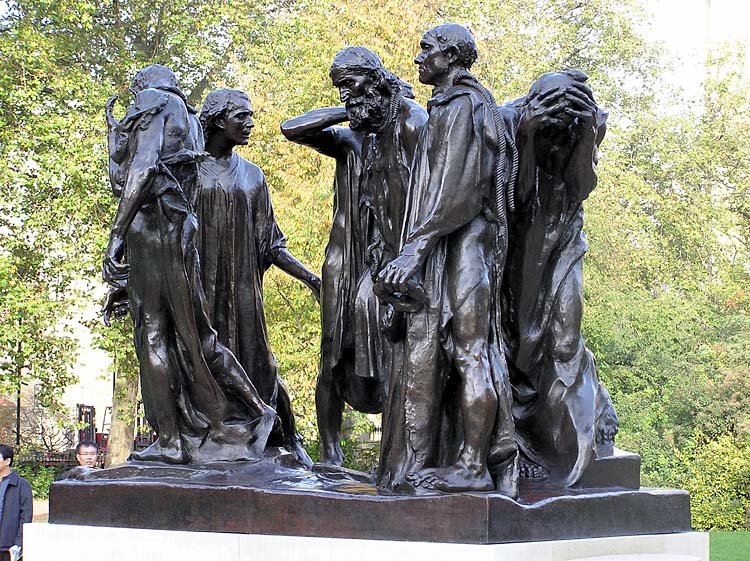
Rodin had a somewhat lukewarm reception by his late 19th century public. His forms were often thick and awkward, with large hands and feet, coarse features, and strange poses. But now, it is those very features that draw the eye to his sculptures, expressing the full range of emotions, ideas, and states of mind. Take the "Burgers of Calais" for instance: To the left is a picture of the life-sized sculpture of the 6 Burghers, the town leaders who surrender their own lives, and the keys to the city, to victorious King Edward. The sculpture depicts the point at which the gates of Calais have closed behind the men, and they are left to the will of the angry Edward. What follows is a translation of the chapter from "Tales of Froissart" that details the story. Take the time to read the small print, it's an exceptional story, written almost 600 years ago.

Book I, ch. 145 (Johnes, v. 1, pp. 186-88). After the departure of the king of France, with his army, from the hill of Sangate, the Calesians saw clearly that all hopes of succour were at an end; which occasioned them so much sorrow and distress, that the hardiest could scarcely support it. They entreated, therefore, most earnestly, the lord John de Vienne, their governor, to mount upon the battlements, and make a sign that he wished to hold a parley. The king of England, upon hearing this, sent to him sir Walter Manny and lord Basset.
When they were come near, the lord de Vienne said to them, “Dear gentlemen, you who are very valiant knights, know that the king of France, whose subjects we are, has sent us hither to defend this town and castle from all harm and damage: this we have done to the best of our abilities. All hopes of help have now left us, so that we are most exceedingly straitened; and if the gallant king, your lord, have not pity upon us, we must perish with hunger. I therefore entreat, that you would beg of him to have compassion on us, and to have the goodness to allow us to depart in the state we are in, and that he will be satisfied with having possession of the town and castle, with all that is within them, as he will find therein riches enough to content him.”
To this sir Walter Manny replied: “John, we are not ignorant of what the king our lord’s · intentions are; for he has told them to us: know then, that it is not his pleasure you should get off so; for he is resolved that you surrender yourselves solely to his will, to allow those whom he pleases their ransom, or to put them to death; for the Calesians have done him so much mischief, and have, by their obstinate defence, cost him so many lives and so much money, that he is mightily enraged.”
The lord de Vienne answered: “These conditions are too hard for us. We are but a small number of knights and squires, who have loyally served our lord and master, as you would have done, and have suffered much ill and disquiet; but we will endure more than any men ever did in a similar situation, before we consent that the smallest boy in the town should fare worse than the best. I therefore once more entreat you, out of compassion, to return to the king of England, and beg of him to have pity on us he will, I trust, grant you this favour: for I have such an opinion of his gallantry as to hope, that, through God’s mercy, he will alter his mind.”
The two lords returned to the king, and related what had passed. The king said he had no intentions of complying with the request, but should insist that they surrendered themselves unconditionally to his will.
Sir Walter replied: “My lord you may be to blame in this, as you will set us a very bad example; for if you order us to go to any of your castles, we shall not obey you so cheerfully, if you put these people to death; for they will retaliate upon us, in a similar case.” Many barons who were then present supported this opinion.
Upon which the king replied: “Gentlemen, I am not so obstinate as to hold my opinion alone against you all: sir Walter, you will inform the governor of Calais, that the only grace he must expect from me is, that six of the principal citizens of Calais march out of the town, with bare heads and feet, with ropes round their necks, and the keys of the town and castle in their hands. These six persons shall be at my absolute disposal, and the remainder of the inhabitants pardoned.”
Sir Walter returned to the lord de Vienne, who was waiting for him on the battlements, and told him all that he had been able to gain from the king. “I beg of you,” replied the governor, “that you would be so good as to remain here a little, while I go and relate all that has passed to the townsmen; for, as they have desired me to undertake this, it is but proper they should know the result of it.”
He went to the market-place, and caused the bell to be rung; upon which all the inhabitants, men and women, assembled in the townhall. He then related to them what he had said, and the answers he had received; and that he could not obtain any conditions more favourable, to which they must give a short and immediate answer. This information caused the greatest lamentations and despair; so that the hardest heart would have had compassion on them; even the lord de Vienne wept bitterly.
After a short time, the most wealthy citizen of the town, by name Eustace de St. Pierre, rose up and said: “Gentlemen, both high and low, it would be a very great pity to suffer so many people to die through famine, if any means could be found to prevent it; and it would be highly meritorious in the eyes of our Saviour, if such misery could be averted. I have such faith and trust in finding grace before God, if I die to save my townsmen, that I name myself as first of the six.” When Eustace had done speaking, they all rose up and almost worshipped him: many cast themselves at his feet with tears and groans Another citizen, very rich and respected, rose up and said, he would be the second to his companion, Eustace; his name was John Daire. After him, James Wisant, who was very rich in merchandise and lands, offered himself, as companion to his two cousins; as did Peter Wisant, his brother. Two others then named themselves, which completed the number demanded by the king of England.
The lord John de Vienne then mounted a small hackney, for it was with difficulty that he could walk, and conducted them to the gate. There was the greatest sorrow and lamentation all over the town; and in such manner were they attended to the gate, which the governor ordered to be opened, and then shut upon him and the six citizens, whom he led to the barriers, and said to sir Walter Manny, who was there waiting for him, “I deliver up to you, as governor of Calais, with the consent of the inhabitants, these six citizens; and I swear to you that they were, and are at this day, the most wealthy and respectable inhabitants of Calais. I beg of you, gentle sir, that you would have the goodness to beseech the king, that they may not be put to death.”
“I cannot answer for what the king will do with them,” replied sir Walter, “but you may depend that I will do all in my power to save them.” The barriers were opened, when these six citizens advanced towards the pavilion of the king, and the lord de Vienne re-entered the town.
When sir Walter Manny had presented these six citizens to the king, they fell upon their knees, and, with uplifted hands, said, “Most gallant king, see before you six citizens of Calais, who have been capital merchants, and who bring you the keys of the castle and of the town. We surrender ourselves to your absolute will and pleasure, in order to save the remainder of the inhabitants of Calais, who have suffered much distress and misery. Condescend, therefore, out of your nobleness of mind, to have mercy and compassion upon us”
All the barons, knights, and squires, that were assembled there in great numbers, wept at this sight. The king eyed them with angry looks, (for he hated much the people of Calais, for the great losses he had formerly suffered from them at sea,) and ordered their heads to be stricken off. All present entreated the king, that he would be more merciful to them, but he would not listen to them.
Then sir Walter Manny said, “Ah, gentle king, let me beseech you to restrain your anger: you have the reputation of great nobleness of soul, do not therefore tarnish it by such an act as this, nor allow any one to speak in a disgraceful manner of you. In this instance, all the world will say you have acted cruelly, if you put to death six such respectable persons, who, of their own free will, have surrendered themselves to your mercy, in order to save their fellow-citizens.”
Upon this, the, king gave a wink, saying, “Be it so,” and ordered the headsman to be sent for; for that the Calesians had done him so much damage, it was proper they should suffer for it.
The queen of Eng land, who at that time was very big with child, fell on her knees, and with tears said, “Ah, gentle sir, since I have crossed the sea with great danger to see you, I have never asked you one favour: now, I most humbly ask as a gift, for the sake of the Son of the blessed Mary, and for your love to me, that you will be merciful to these six men.”
The king looked at her for some time in silence, and then said; “Ah, lady, I wish you had been anywhere else than here: you have entreated in such a manner that I cannot refuse you; I therefore give them to you, to do as you please with them.” The queen conducted the six citizens to her apartments, and had the halters taken from round their necks, after which she new clothed them, and served them with a plentiful dinner: she then presented each with six nobles, and had them escorted out of the camp in safety.


If, after looking at Rodin's Burghers and reading their story, your eyes haven't at least misted over a little, you either read too quickly or have a heart of stone. I read that story in the museum with the burghers in full view, and wept for them along with Sir Walter and the people of Calais. Beth and I decided that we needed to know more about Edward's queen, Philippa, who could turn away his anger and bring about a merciful end to the story. If you want to read more about Rodin and the Burghers, here's a link, hopefully it works for you:
http://www.metmuseum.org/explore/publications/pdfs/burghers/divided/storyBurghers.pdf#search=%22The%20burghers%20of%20calais%22

After further transports of emotion and thought, thanks to Mssr Rodin, we took the Metro back to Ile de la Cite, the larger Seine island that holds Notre Dame and Sainte Chapelle. We made it to Notre Dame just in time for the vespers, an experience not to be missed if you are musical. The grand organ, the beautiful bel canto singing, and the incredible grandeur of the cathedral is beyond description. We had slipped into the back rows a little after vespers began, so in the few minutes between the vespers and mass, we moved to the front third of the pews. We were still at least 30 rows back from the altar.

The mass was in latin and French, so we missed the point of the homily, but the readings were from Isaiah 35:4-7 ("then will the eyes of the blind be opened"), James 2:1-5 (my brothers, show no partiality), and Mark 7:31-37 (Jesus heals the deaf and mute man). The whole service exalted the glory and majesty of God. We left knowing that God's presence was there with us even if we didn't understand all of the words.

Dinner was at La Flore de l'Ile, a cafe just across the little bridge on Ile St. Louis. Back at the hotel Beth relaxed, I wrote this blog, and now it's time for bed. Tomorrow it's back to work for most Parisians, as the little phrase goes: metro, boulot, do-do (subway, work, beddy-bye)...

Saturday, September 09, 2006

Potpourri


I noticed that in my post from yesterday (Saturday) that I didn't give a teaser line at the end, advertising what today's post would be about. That means I can talk about anything I want. Like potpourri. Everyone knows what that is: a mixture of dried flower petals and spices in a bowl to spice up the room. In a more general sense, it means a mixture of things or a medley, which is what I plan for today. Being a word guy, I couldn't leave well enough alone, so I looked up where the word came from. As is the case in 60% of all words in an English language dictionary, the word is French in origin.

That's right, Mac: 60% of the words that leave your mouth every day were invented by the French. "What?" you say, "you mean I have to give credit to those crummy Frenchies just for being able to call them crummy?" Well, actually the word crummy comes from the Old English word crumme, and so is one of the 40% of words not invented by those crummy Frenchies. My point is that while many Americans don't hold the French in high regard for a number of political and social reasons, we owe them a lot in regards to the language we speak.

It's time for a very brief history lesson: in 1066 William of Normandy (aka William the Conquerer) crossed the Manche (the Brits call it the English Channel) and won the Battle of Hastings, putting the Angles and Saxons (thus Anglo-Saxon) of England (Angle-land) under French control for 300 years or so. The battle is recorded on the most amazing tapestry, called the Bayeaux Tapestry, pictured above. The tapestry, a 270 foot long by 20 inch wide strip of embroidered cloth, was made in the years following William's victory, and is still on display in the town of Bayeaux, in Normandy. During this time of French dominance, if you wanted to make anything of yourself, you had to learn Old French so you could hobnob with the winners. Over 300 years, the Brits merged Old French with Old English, and by Shakespeare's time, the English we speak was essentially completely developed, borrowing 60% of its words from the French side.

Not to beat a dead horse, but most of the 3 syllable words you speak, and all of them ending in -tion, -cion, -ate, -ic, -ive, and many others are French, and can be used almost unchanged today (except for the funny accent) if you are speaking French. Most of the 1 syllable words in English are from Old English, which descended from Old Norse, Scandinavian, and Germanic languages. So next time you discuss politics (from OF politique), religion (OF religio), or culture (OF culture), realize that you have to tip your hat to the Frenchies regardless of how you feel about their actual views on politics, religion, or culture....

A bit of potpourri right there, I guess. I hope this blog doesn't resemble the word too much, though, since the word actually means "decayed material in a pot" (pot-pourri). Hopefully, this will perfume your mental room with a nice smell, not a stinky one. I do have one or two bathroom-related items, however.

Most dog owners in Paris are apparently on a mission: get Fifi around the required circuit and get back to the apartment in a reasonable amount of time so they can do other things. The dogs, on the other hand, have no mission save to wet every vertical fixed object within reach (like all dogs). Occasionally we run into a person without such a mission, and then Beth springs into action: "Oh! Tu est un gentil toutou! Comment tu t'appeles? Oh, tres joli!" and the like. Sometimes the Parisienne (usually a lady) will stop and let Beth pet the dog, giving her something akin to an addict's high, which lasts only until she sees the next dog....

What's the deal with bathrooms around here, anyway? Most restaurants have just one, a one-holer unisex bathroom in a closet smaller than the average dresser. No building inspector in the States would let these restaurants stuff their clientele into such tiny holes in the wall. At least the toilets themselves are very efficient, better than ours in the States. And the whole thing is a lot better than the "squattie potties" one finds in most of Asia. Chock one up for Western culture....

In French, a "blague" is a joke, a prank or a tall tale. Entirely coincidentally, it is pronounced almost exactly like the word "blog"....

We watched a bride and groom being driven down rue de Rivoli yesterday afternoon, followed by at least 50 honking well-wishers. They completely blocked traffic for 15 minutes or so. I couldn't help but think about the opening minutes of Gershwin's "An American In Paris" orchestration, with traffic noise and honking horns. Instead of shaving cream and tin cans, though, they had tied large bouquets of flowers to the grills of the cars, and pieces of lace to the antennas. Always tres chic, those French.

Family and home are very important to the French, and perhaps more so in the last few years. We spoke with the proprietor of a little boutique who was displaying Christmas ornaments. We remarked that we didn't realize that Europeans cared much about Christmas and other religious holidays, given all we read in the press about how secular Europe has become. She said that, especially since 9/11, the French have begun to focus a lot more on religious holidays like Christmas and Easter, not in the crassly commercial way we see a lot in the States, but by decorating more and earlier, and observing more of the traditions of the holidays. It's not exactly the Reformation all over again, but it's encouraging for those of us who think that the Christian religion has an important place in family life, as well as culture.

Tomorrow: people watching and the Da Vinci Code...

When the going gets tough...


The tough go shopping, of course. French lesson #2 with Marguerite yesterday clearly illuminated the vast cavern that remains between us and proficiency in the French language. We sat at a Cafe in the Place des Vosges and spent 45 minutes learning more grammer and vocabulary, then strolled around the square visiting many of the chic art galleries and boutiques there. Marguerite would ask us a question like "what do you think of the frame around that painting?" We would answer "yes, I'm enjoying Paris very much, thank you" or some other bizarre non sequitur. For a French speaker, it must be excruciating, although also highly entertaining. Marguerite takes it all very patiently and sweetly, then assigns us a thick stack of homework.

Beth was especially distraight after the lesson was over, having worked for a couple of hours on her workbook without showing much success in the lesson. In an effort to lift the spirit, we left the Place des Vosges and headed down rue des Francs-Bourgeois. It's a funny name: as far as I can tell, it means the street of "frank middle-class men," so I supose a lot of blunt truth-telling goes on between briefcase-toting accountants and businessmen on that street, although all we saw were shoppers sauntering and couples laughing. Maybe all the francs bourgeois were still at the office.

Along that street there is a little courtyard with a shop called ImeX, where Beth bought a beautiful faux fur coat when we were here last year. We popped in there to see if they had anything interesting, and sure enough they did: practically the whole shop. The same 2 ladies who helped us last year were there again, and recognized Beth's red hair. We recognized their red hair as well, that mahogany red tint that is apparently a la mode all over Paris among the middle-aged ladies. At least it's better than the blue hair favored by many older American ladies. The red-headed duo practically turned themselves inside out showing us all their chic sweaters, coats, scarves, and hats. Beth consoled herself with a lovely furry brown coat to replace one that she has loved and long worn out, a very smart faux brown leather jacket with a lining of what looks like shearling fur dyed burnt orange, and a sweater.

You may be wondering, having read this far, and maybe a lot farther than this if you've been following this blog, why I don't mention visits to the Eiffel Tower, the Arc de Triomphe, or Notre Dame church, except in passing. Alright, here's the deal: last year we came to Paris equipped with "Top 10 Paris: Your Guide to the 10 Best of Everything" published by DK (Dorling Kindersley). Here are their top 10, in order:
1. Musee du Louvre (you know, Da Vinci Code and all) pictured right with the giant glass pyramid
2. Musee d'Orsay (all impressionists all the time)
3. Eiffel Tower (was actually supposed to be dismantled after the 1900 world exhibition)
4. Notre-Dame church (didn't see Quasimodo, but loved the gargoyles)
5. Sacre-Coeur church (the best view of central Paris, better than from the Eiffel Tower)
6. Arc de Triomphe (Napoleon's monument to himself)
7. Centre Georges Pompidou (the museum of modern art)
8. Pantheon (where the heavies are buried, like Voltaire and Victor Hugo)
9. Sainte-Chapelle (St. Louis paid more for the relics than the entire cathedral)
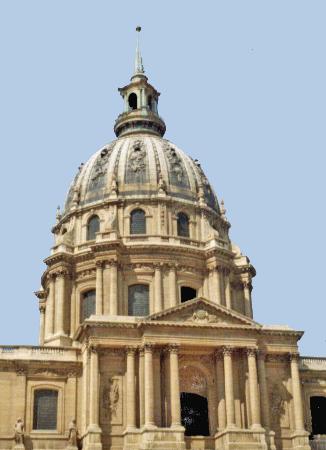
10.Hotel des Invalides (the Sun King built it for his veterans, Napoleon is buried there), pictured at the top of the blog.

Voila! Paris Top 10, and you didn't even have to pay $15 for the guidebook. Last year, we saw all 10 close up except the Louvre, which was just too daunting for Beth, the art history buff. This year, we plan to go to the Louvre, including a 2.5 hour guided tour to the "jewels" of the Louvre, and to Musee d'Orsay as well. We love going to Notre-Dame and Sacre Coeur for masses--even though we are protestants and the service is in French and Latin, it is clear to us that God is present there, and I'm sure He knows those languages as well as English. The others, at this point at least, are in the "been there, done that, got the T-shirt" category. The bridges of Paris are another story altogether, and we plan to walk all of them one of these romantic evenings, maybe tonight after mass.

Last night we finished our shopping spree around 7pm, mostly because the stores closed--Beth has seemingly unquenchable appetite for shopping, like most able-bodied women would in Paris. She doesn't usually buy much, being budget-minded, but loves to look at all the unique and beautiful things. I don't recall seeing any of this stuff in Walmart.

A short stop off at the hotel to drop off packages and freshen up, and we were off to a delightful little restaurant north of our hotel called Le Dome du Marais. The building was built in 1778 (2 years after the Declaration of Independence was signed) by the last French king, Louis 16th. He lost his head 15 years later along with his Austrian-born queen Marie Antoinette during the reign of terror after the French Revolution. The building housed his pawnshop: apparently, governments were more creative in those days with regards to income than they are now. It actually remained a pawnshop until 1981, when it became a restaurant. And a belle restaurant it is.

The meal was as memorable as any we've had in Paris, with a two-course "amuse bouche" of a small slice of onion and olive bread with tiny portions of cold radish soup and finely diced carrots and green onions. The entree ("entry," or first course, not the main attraction as we use the word in Engish) was a tomato cooked for 10 hours with herbs for Beth, and for me, a fabulous salad of spinach leaves with cooked sliced mushrooms and a filet of foie gras (yes, I know that the geese are force-fed to fatten their livers, but I'm telling you, it's just about the best delicacy I've ever had). The main course was cote du veau, a single large veal cutlet cooked au jus and served for 2 with french-cut buttered green beans and a hot legume side dish. Dessert (hey, it comes with one of these prix fixe meals) was a small tarte of fresh berries and thin crispy wafers for Beth, and a souffle for me-perfectly done. Coffee, tea verveine, and some madeleines, and we were ready for do-do (bedtime). After reading this far, you are probably as sleepy as we were, so good night for now.

By the way, when we visited the local post office to buy some stamps, we noticed that the clerks all sit behind 3/4 inch thick plate glass with giant glass turntables to pass your packages through for mailing. Maybe "going postal" doesn't just happen in the States...

Thursday, September 07, 2006

Les Grands Magasins and "we shoulda taken the Metro"


Marguerite, our new French instructor, asked us when we first met her whether we were still jet-lagged. I said no, but I didn't tell her why: we have a secret weapon against jet-lag. I've heard all kinds of tricks to use when travelling east versus west, and while some of them work a little, here's what really works: if you keep going to bed 16 hours after you woke up, and then sleep for 8 hours, you never feel jet-lagged. It works! There's one small incovenience: since Paris is 7 hours ahead of CST, that means we have to keep going to bed at 6am and waking up at 2 pm to stay on schedule. Darn it all if the maid doesn't keep knocking around 11am to see if she can make up the room!

Seriously, we don't go to bed at 6 am, but being night-owls naturally, the time change has made it almost impossible to go to sleep before 1am, or to wake up before about 9am. It's not really a problem in "the City of Lights" because people are out and about until 1 or 2am anyway, so we seem to fit right in. The only real problem (if you consider it a problem: I don't but Beth does) is that the stores all close at 7 or 7:30pm, so if a day of shopping the department stores (les grands magasins) is in the plans, you have to get going early or you'll miss half the stuff by closing time.

Suffice it to say, we missed more than half the stuff today which was fine for me but a frustration for Beth. We got out the door at the usual hour (noon or so), and decided to walk from our hotel to Printemps, one of several HUGE French department stores (pictured above). It is located between the Madeleine church and the Opera Garnier north of the Louvre museum. It's quite a walk, maybe 45 minutes on foot, but even at that, we took the long way: we stopped to shop in shoe stores along the way. You have no idea how many shoe stores there are on the rue de Rivoli in a 12 block stretch. I went crosseyed looking at all those shoes, boots, sandals, loafers, ballet slippers, pumps, etc. Girls, you can snicker, but you have no idea what it's like to be a guy shopping. The walking is no problem, since guys are usually the ones with the low-heeled, comfortable shoes, and the girls are tottering around on high heels or in sandals made of tiny pieces of leather better suited for a keychain than a shoe.

No, it's the actual store that's the problem. I've looked into this, and I've figured it out. Trust me, I'm a doctor. Here's the problem: just like Superman, the average guy is able to take all kinds of abuse with a superhero's patience, like hanging wallpaper and having dinner with the in-laws. But just like our Man of Steel, every guy has his Kryptonite. You know, the glowing blue mineral that saps his strength and reduces him to a damp spot on the floor, crying "I'm melting, melting...." For most guys, their Kryptonite is located somewhere near the center of any mall or shopping district. The closer we get to the epicenter of shopping, the weaker (Beth says crabbier) we get. We weren't even close to Printemps at this point, and I was already a goner.

Fortunately, there is an antidote for the average guy's Kryptonite, and it's (surprise): food. After completely exhausting myself over the shoes, I practically crawled to the Tulleries, a large garden/park near the Louvre museum with just enough strength to order "deux boules des glaces et une boteille d'eau minerale" to which the server replied, "you want 2 bowls of ice cream and a bottle of mineral water, right?" It turns out that French is not obligatoire everywhere in Paris, especially where a lot of Americans congregate. After consuming the flavorful small scoops of coconut and dark chocolate ice cream (nothing in Paris is Texas-sized), we felt revived enough to tackle Printemps, knowing that the Place de la Madeleine was waiting afterwards.

Printemps and its competitor, Galeries Lafayette, are les grands magasins (the large department stores) in Paris. Printemps has 3 large buildings and 7 to 9 floors each, depending on the building. One building for women (9 floors there, of course), one for the home, and the smallest for men (what guy in his right mind would go to a place where he has 9 floors of stuff to sift through?). As a mercy to the male reader, I will forgo detailed descriptions of this section (first we sifted through the cosmetics, then the hair doodads, then the designer clothes, etc.). From my standpoint, we went up and down the escalators to every floor at least once, mostly in the women's building, and looked at everything. Veni, vidi, vici. Obviously, Julius Caesar never went shopping in Paris, or he would have never been able to say that. Fortunately, there is a terrace on top of the building with a scenic view of all of Paris, and a cafe (pictured to the right), so again I was saved from perishing by coffee and pie.

Beth is quite budget-minded, and rarely buys much when we shop. Fortunately we don't go to any stores like Best Buy here in Paris, because I'm not nearly so disciplined, and we would be dragging home a flat screen TV or something like that instead of some stationary, rubber stamps, hairbrushes, and a microwave egg cooker.

Having conquered Printemps, we marched to the Place de la Madeleine, where the best of the best of Paris delis compete with one another: Fouchon versus Laduree versus Hediard. You can tell from the little puddles of drool in front of the windows which one is winning on any given day. We wandered through all three, bagging some tea in Fouchon and macarons in Laduree. The macaron is one of the delicacies closest to ambrosia, the food of the gods, and the sweet filled cookies have a price to go with their taste. One doesn't eat a macaron, one savors it, taking in the delicate outer crust, the tender, chewy middle, and the sweet and contrasting filling. Beth's favorite flavors are pistacchio and caramel, mine are cafe (coffee) and caramel. These are entirely unrelated to coconut macaroons, which while tasty, are very terrestrial when compared with Laduree's ambrosia. We did not sample the package, but tucked it safely into another bag and set out for home.

On the way back to our hotel, we shopped along the rue St. Honore, which evidently has been weakening men and accessorizing women since the 1600s when it began as a chic shopping district. In my ever-weakening state, I became convinced that someone had moved our hotel several miles further to the east, and I realized belatedly that we should have taken the Metro back to the hotel. Finally we spotted l'Hotel de Ville (City Hall, which is hard to miss and is close to our hotel), and I knew I would live to survive another day in Paris.

Nearby, we popped into a Supermarche, which is brand of grocery store that is anything but a supermarket by American standards, being little larger than a Holiday gas station, minus the gas. We bought some lovely smoked ham and chocolate, and had a little picnic in our room with the bread, pain au chocolat, croissant, and kiwi fruit left over from breakfast. Then we savored our macarons and daydreamed about the Elysian Fields. We toiled for an hour or two over our French assignment, made a reservation for a Louvre museum tour with a company called Paris Muse for Monday morning, and put the day to bed.

Before I go for the day let me mention that everywhere we go we see cell phones, and people talking constantly. Interestingly, we see very few Ipods. Like I've said already, the French like to talk. This culture seems to be more relationship based, and less productivity or privacy obsessed, than ours. Interesting.

Tomorrow: when the going gets tough...

French as you like it and an anglo sing-along


I'll admit it: I am a word guy. I love having le mot juste, the right word or phrase to get the job done with savoir faire. Some of you know that I've been toying with learning French using the Yale University video and audio program "French in Action". It's a program of first and second year French using 52 half hour lessons that follow a young French girl and a young American guy as they meet, get to know each other, and have adventures in Paris and the provinces. It has been fun, but it's a little one-way.

So, while googling some French website or another to find hours of operation of the Louvre or the Musee d'Orsay (the impressionist museum housed in a glorious early 1900s Paris train station), I stumbled upon a google ad for "French as you like it." The proprietress, Marguerite Monnier, shown above, is a twenty-something Frenchwoman with a business degree who worked for 5 years in San Francisco in international marketing before returning to Paris last year. Having evidently listened patiently to a number of Americans (like myself) stumble through a French conversation, she decided to do something about it. She now gets PAID to listen to Americans bumble through a French conversation, forcing us to repeat ourselves until we get it right.

Beth and I met with Marguerite yesterday, and she evidently didn't think we were a total loss, since she agreed to take us on. She did recommend 3 lessons per week, so I think she secretly feels like the project is going to require some very heavy lifting. Since Beth and I are on somewhat different levels, she is starting with the basics so Beth can catch up a little. Beth is such a quick study that I'm afraid she'll pass me up about the fourth lesson or so, and never look back.

After an hour and a half of basic grammar and vocabulary, she assigned us a lesson book, so we set off in search of Gibert Jeune, a bookstore on the left bank near the Sorbonne (Paris' most famous university). We took the same route as I described a few days ago, past the front of Notre Dame and across to St. Germain de Pres and the Latin Quarter. Marguerite told us that the bookstore was on Blvd. St. Michel at the Place St. Michel, so we crossed Blvd. St. Germain and looked. We never found Place St. Michel or Gibert Jeune, but we found Gibert Joseph, a different bookstore with almost exactly the same name, also on Blvd. St. Michel. We took it as a sign that this was in fact a better store for us, and plunged in. The store has five levels and six different buildings, most of which do not interconnect. A veritable ocean of books, textbooks, paper, and supplies. Adding to the feeling of drowning was the fact that it was full to the brim with school children and their mothers, and college students, all scrambling to get school supplies. The air was full of "excuse-moi" and "pardon" and "mon Dieu, quels stupide Americains." Well, I didn't exactly hear the latter, French people being basically polite and all.

We found the textbook we needed, which is "nivel debutant", or rank beginner level. Feeling a little miffed at being debutants at our age, we bought the nivel intermediare as a challenge. Maybe we'll get there, and maybe we won't. We'll see. While at Gibert Joseph, Beth spied an art paper section, and being an artist, bought basically one of each. I had no idea there were so many different kinds of colored paper: metallic, opaque, heavy, light, vellum, corrugated, dimpled, vegetable. Vegetable? Yup. When we got to the counter, the clerk had to unscramble the entire stack into each type of paper, because they were all priced differently. I tried to tell him we were sorry that the papers were all scrambled up, but I think I told him we were from Outer Mongolia and had our Yak waiting outside, based on the puzzled look he gave us.

We window shopped along Blvd. St. Michel while walking back toward the Seine river. Beth's shopping pace is quite a bit faster than the usual French saunter, and was even a tad faster than usual. Finally, crossing Pont St. Louis from the Ile de la Cite to Ile St. Louis, Beth just wigged out when she got stuck between a sauntering couple ahead and a brisk businessman behind. Unable to take any more of the crush, she snapped. I realized later that people of Scandinavian background have a much larger personal space need than French people, and she had been surrounded all afternoon by practically the entire population of Central Paris.

I led her down rue St. Louis, a quiet lane that bisects l'Ile St. Louis, and after reading the menus of maybe five other little restaurants, we picked one called Le Relais de l'Ile. A Relais is a "relay", a kind of roadhouse that used to be used as a rest stop, sort of like those used in the States for the Pony Express. This cute little place had 6 or 8 tables on the main floor in a space smaller than the average hotel room, and 2 tables perched somewhat precariously on a small balcony next to the kitchen. The proprietress was a slender middle aged lady with a very pleasant air who seated us at one of the front tables. The table, as usual in Paris, was a little bigger than a school lunch tray, but it's amazing how many plates, saucers, utensils, and glasses she was able to squeeze onto it. After watching her walk up and down a flight of stairs every time she had a table to serve, I realized why she was so slender: she probably made 200 trips up and down those stairs every day.

A Frenchman was playing jazz piano (think Gershwin, not Thelonious Monk), and knew every Scott Joplin, Gershwin, Charles Trenet, and Edith Piaf song known to man, as well as "Mac the Knife" and practically every other song we requested. The tables were essentially full, but everyone was anglo except the people perched on the balcony, who were French. At the end of the evening there were 3 tables of Americans left (including ourselves), and we had a lovely anglo sing-along to the likes of "Autumn Leaves", "Ain't She Sweet", and, of course, "As Time Goes By" (or "Play it Again, Sam" as most people know it from Casablanca). Evidently the French don't frequent jazz restaurants very much, probably because they like to talk so much (see previous posts) and can't hear well enough with all that music playing.

For you BBC fans, we are sure we spotted Rumpole and "she who must be obeyed" at an adjacent table. He grumbled quite a bit and didn't stay long, so I didn't get his autograph.

Tomorrow: les grands magasins and the Metro...

Tuesday, September 05, 2006

A petit crisis, bulk shopping and ambulances


Disclaimer: I can't always predict the future perfectly, so just because I promised something in my teaser line yesterday, it doesn't necessarily mean that I will actually talk about it today. It's true that I have in the past, and sometimes successfully, talked about subjects of which I know nothing, but in a blog like this, I'm assuming the reader wants the truth and not some fairy story.

So, we crossed no bridges and saw no gardens today--sorry for the bait and switch. The morning actually started out with a bit of a crisis which turned out to be a tempest in a teapot. This particular crisis began when we arrived in Paris-Charles de Gaul airport on Saturday in our slightly sleep-deprived state. We dimly realized that we didn't go through the usual passport-stamping line that we've always enjoyed whenever we travel abroad. You know: stumble off the airplane, go through the cattle-run hallways, into a wide hall with lots of empty stations and only 2 or 3 agents actually present. One for U.S. citizens, one for all others, and one to watch the other 2 stamping the passports.

When we got to the baggage claim, we realized that we had missed the cattle run, so we proceeded to customs and inquired about needing a passport stamp. I showed my passport to one of the officers, and he gravely examined it. He triumphantly pointed to a stamp and said, "there it is!" I explained to him that that particular stamp was the one I got in Reykjavik, Iceland on the way to Paris, but that no one in Paris had yet stamped my passport. He gave a perfect French shoulder shrug and said, "no problem, everything is fine." Ultimately, we decided to take him at his word despite our doubts, and wheeled our bags out to the taxi stand.

Later, we talked about it, and began to worry that we might have trouble getting out of France (not an unpleasant problem: "sorry Larry, I'm stuck in Paris for the next 2 months while the authorities iron out our immigration problem") or getting into the U.S. (less pleasant, since there's no place like home, even after a wonderful vacation). We decided that the best way to find out was to check in with the authorities. I know, I know, if you want tax advice, the last place you go is the IRS. Still, I decided that I had paid enough embassy salaries with my tax dollars over the years that I should avail myself of their services while in Paris. I was going to call on Monday, but realized that it was Labor Day, so I doubted that anyone in the American embassy would be allowed to labor on such a holiday, so I waited until yesterday.

We called the U.S. Embassy and immediately talked to: an answering machine. Having run the gauntlet of choices to find the right "real person" to talk to, I found out several things: first, pressing zero is almost always the fastest way to get a real voice, whether they're in the correct office or not; and second, as a privileged American, I don't have to pay to talk to the embassy personnel, but if I were a lowly Frenchman, I would have to pay (American enterprise at work). That's right, folks, your government is working for you, making money at every opportunity, just for you.

The operator was definitely French, but I don't think she had to pay any money to speak with me. She transferred me to another office where I spoke with another woman with nearly flawless English, but whom I still suspect was French. I'm a little worried that there may have been a bloodless coup at the embassy, and now the French government is making money off their own citizens' phone calls and stealing it out of the mouths of hungry Americans. The lady listened to my plight and laughed. "Now, you have to ask them to stamp your passport if you want a souvenir from the airport." She assured me that the U.S. government would indeed let us back into the country when we returned. "Even without the stamp, you cannot stay longer than your trip allows." Darn. Larry, I guess I will be back by the end of the month after all.

We met the hotel owner yesterday as well. We talked for a long time about a number of things (remember, the French love to talk), and finally got some shopping tips from him. North of our hotel, still in the Marais, it seems that there is a veritable Chinatown, importers of all kinds of wonderful stuff. Beth loves to shop for stuff, so off we went to investigate. We went into store after store of costume jewelry, purses, ready-to-wear, and bricabrac, and Beth was enthralled. Then we read a sign, one that was on nearly every store's door: "vente en gros seulement", which means that unless you plan to buy 50 of the same necklace or purse, you're out of luck. Imagine our chagrin. We ended the shopping spree with a trip to Pylones, a bricabrac store with all kinds of whimsical objects. You could get, in the same colorful and unusual style, anything from a cute plastic baby bib (which we bought) to a cute little tin of condoms (which we did not). Ultimately, the shopping excursion was salvaged by Pylones and a trip to Mariage Freres, a tea shop and boutique with every kind of tea known to man in large tins lining the wall.

Several times each day we hear the ambulance or police go by with their two-note siren and I immediately expect to see Inspector Clouseau from the Pink Panther movies coming around the corner asking "do you have a license for your monkey?" So far, no inspector and no monkey yet.

Tomorrow: French as you like it...

La vie quotidienne

Almost everything about daily life in Paris is inefficient. Fortunately, it's a fairly pleasant sort of inefficiency, like the uncommon kind of airline inefficiency that keeps you in Maui an extra day. Traffic is often snarled up, so the morning commute is long unless you take the subway (fairly pleasant) or live close enough to walk or bike to work (even more pleasant). Evening meals take, well, all evening. In conversation, if a group of people are talking and someone approaches the group, everyone stops to shake his hand (if he's a guy) or do the double kiss on the cheek (if she's a girl). Then they all start talking again. And the French do like to talk!

Even the language itself is pleasantly inefficient--so many letters go unpronounced, with so many words just to say one idea. Take the word "today" for example: "aujourd'hui" is actually a contraction of 5 different words. "At the day of today". Apparently when the ancient French linguists were inventing words, the word they came up with for "today" (hui) sounded exactly like the word they came up with for "yes" (oui). So they added the clarifying phrase aujourd', made up of au (a contraction of "a la" or at the), jour (day), and d' (of or from). Confusing? You bet!

Undaunted by the inefficiencies, we set out (on foot) yesterday afternoon for St. Germain de Pres, a lovely left bank quarter in the 6th arrondissment with loads of restaurants, shops, and parks. From our hotel, it's a 30 minute stroll through the Marais (our neighborhood) along the rue de Rivoli, down to the Seine river, over the pont d'arcole bridge onto the Ile de la Cite, right past the front of Notre Dame church, and off the island across the bridge to the left bank. From there it's a short jaunt to Blvd. Saint Germain where all the action is.

I had noticed earlier that Beth's nice sunglasses were a little crooked on her face (she likes them alot and uses them all the time). We bought them last year at a little opticien shop on Blvd. Saint Germain owned by Serge Wajeman. Serge was very glad to see us again (I'm not really sure he recognized us, but he acted like we were good friends). He adjusted the sunglasses and sold me a tiny pair of reading glasses to carry in my pocket for those french menus. Last year he had recommended a restaurant to us, Chez Fernand, a block from St. Sulpice church (made infamous in The Da Vinci Code as the site of a nun's murder). We remembered having a lovely meal there, and asked him for directions again, since we had gotten a little lost trying to find it last year.

He said it was simple to get there. When his written instructions ran to the 3rd line of the paper, I said it didn't seem all that simple to me. Much to our amazement, he promptly locked the door of his shop and proceeded to walk us to the restaurant. It was around closing time anyway, he said, and since he lived nearby, it was no trouble for him. After a rather labyrinthine route, we found the church (it has a beautiful Italianate facade), and the restaurant. After shaking hands with him several times and promising to come see him before we left Paris, he left for his nearby apartment. We made reservations at Chez Fernand for the table in the front (for people watching purposes), and continued shopping. It was 7:15, and only 2 couples were in the restaurant, both of them probably Americans.

We stumbled on a delightful little shop on rue Gregoire de Tours called Artisanats des Monasteres de Bethleem that sells statues, bas reliefs, and creches. We found a beautiful manger scene of a larger size made of dolomie, a resin and crushed rock material. The statues are fairly heavy, and total 14 including Mary, Joseph, and the Child, the Magi, the shepherds, and assorted stable animals. We tried to figure out a way to get the whole entourage home, but gave up reluctantly, at least for now.

We returned to Chez Fernand where we were welcomed to the front table and served quite enthusiastically and briskly by several young men in aprons. It was 8:30 and the restaurant was chock full. Beth had a thick andalusian gazpacho soup with baguettes that I shared with her. We then had a risotto of lobster meat and bisque-like sauce of the house, a filet mignon of pork with au gratin potatoes in an herbed brown gravy sauce with mustard, and for dessert (you aren't a bit surprised, are you?) a fondant au chocolat and a tarte aux abricots with a little bit of vanilla ice cream. As usual, our evening meal took, well, all evening.

We were there for several hours, just talking and people-watching. Apparently we pulled a coup getting the front table, because the most well-dressed Parisian couples kept standing outside the restaurant looking at us jealously and talking in hushed tones. When they realized that we weren't going anywhere, they reluctantly ducked inside and took another table. For our entire stay, the table next to us was filled with couples who never stopped talking. When one was chewing, the other was talking and vice versa. Like I said, the French really like to talk. If you were unkind, you might suggest that I'd fit in very well here. And I would.

Tomorrow: bridges and gardens...

Monday, September 04, 2006

Il Pleut


Rain! In Paris! Ce n'est pas possible! According to the French videos I watched to learn to parlez a little Francais, it only rains in Angleterre (England), never in France. They lied! When we went to bed last night, it looked like this picture...

We were about to venture out this morning for a day of adventure when the skies opened up and we scuttled back in to watch from our room. Once Beth got back inside, she was overcome with fatigue and has been sleeping for 2 hours. I'll take the time to catch up on yesterday's adventures.

Living the Bohemian life in Paris is hard: ten hours of sleep, up at 10am, a fresh continental breakfast (a real one, not the fakes you get from cheap American hotels--see my previous post for the complete rundown) served in the room, chased out by the maid at noon so she can make the bed, shopping all day at the neighborhood shops.... Uh oh, I can feel the steely gaze of Mrs. Thompson from grade school--we're just going to have to teach those children something useful today. So we ducked into the Musee Carnavalet, a nearby museum of 17th, 18th, and 19th century Parisian history. You can check it out here:
http://www.paris.fr/portail/Culture/Portal.lut?page_id=6468

After that we walked 2 or 3 blocks to Place des Vosges, one of our favorite spots in all of Paris. This is a full city block of connected houses, 3 stories high like almost all of Central Paris, built by Henri IV in the early 1600s for his cronies, so as to avoid too much contact with the riffraff. (This was before Louis XIV, the Sun King, levelled his dad's paltry castle in Versailles, outside of Paris, and built the Palace of Versailles, his cozy 600 room playboy mansion. More about this another day, perhaps.)

In the center of the Place des Vosges there is a very nice garden that is almost a block in size, since the buildings that surround it are only a couple of rooms wide. We sat on a park bench in the garden and people-watched for an hour or so, then made reservations at Coconas, one of our favorite restaurants in all of Paris. It's located in one of the buildings surrounding the garden, and not far from one of the most exclusive and expensive restaurants in all of Paris, L'Amboisie (we ate lunch there when we were here last year, and I think I'm still paying off the credit card). Anyway, we left the Place des Vosges and visited Victor Hugo's house nearby on our way back to the hotel. He was a fascinating guy with a big appetite in every way, a larger-than-life character even for France where characters are welcome. Here's a website:
http://www.hugo-online.org/090200.htm

The shopping in the Marais district is very nice and very pricey, so we looked but didn't touch. After freshening up at the hotel, we headed back to the Place des Vosges to have dinner at Coconas. It's named after a purported French explorer from the 1500s who apparently settled down after his exploits to start a bar & grill so he would have people around to tell his stories to. I'm a little suspicious about the veracity of the story, since the engraving of Mssr Coconas on their business card looks quite a bit like Hernando Cortez. The French have always been a little jealous of the Spanish, and have never forgiven them for going and getting their Armada sunk by Lord Nelson just when Napoleon needed a ride across the English Channel to take over England. It's too bad he didn't wait a bit, since now he could just take the Chunnel train and never get a bit wet.

But I digress. Coconas has wonderful food, served lavishly with bonne humeur, and doesn't use up too many of one's Euros. Since it's almost dinnertime already, I'll dispense quickly with the menu: an "amuse bouche" (freebie little appetizer from the chef so you don't bang your utensils on the table out of hunger waiting for the waiter), fresh cold tomato soup with a viniagrette to sweeten it a little, a Greek salad with toast points spread with the most delicious spicy cream cheese (think Southwestern style). Beth had the fish special, again with a lovely French sauce and several kinds of mushrooms. I had a cote de veau, veal cooked in a sauce in a cast iron dutch oven with gnocchi and morel mushrooms (the chef must have gotten a Sam's club sized package of mushrooms from the market).

For dessert, Beth had a lovely creme au chocolat (thick dark chocolate pudding) with madeleines, and I had a "rainstorm" of strawberries flooding what looked like a coconut macaroon biscuit which actually contained sorbet de fromage blanc (think really good rich vanilla ice cream). To finish, an espresso for me and herbal tea for Beth, and apres dessert, a sort of after dinner amuse bouche of little cookies and mini creme brulees that they bring if you order coffee. I forgot these wonderful little macarons, financiers, and creme brulees last year too, so we were a little overstuffed when we waddled back to the hotel and deposited ourselves in bed. Another exhausting day as a Bohemian in Paris. It's a tough job, but as you can see, we're up to it.

Tomorrow, the rain in Spain fell mainly in Paris today...

La vie Bohemien


Bonjour! I'm back with another exciting episode of "adventures with language"! I left you at BHV, with Beth's face alight with happiness--a real cliffhanger. She apparently survived the ecstacy of the face cream application, because we set out Saturday night for a restaurant called Le Coude Fou, which is literally "the crazy elbow". I think they're referring to one's crazy bone, but it could be a reference to the sort of resaurant mishaps that come from having tables so close together, as French restauranteurs are fond of doing. (Zut alors! I've knocked over your glass with my "coude fou"!)

Anyway, the restaurant was almost deserted when we arrived on a Saturday night at 7:30 (remember this is the "la rentree" or return from summer vacation, so Paris is once again filled up with people for the school year). On previous trips, I thought this meant we had chosen a bad restaurant, but we found out that--even on a very busy night--virtually no one eats out in France before 8 pm. Sure enough, by 9, Le Coude Fou was full to the brim, with crazy elbows everywhere.

The food was very nice: Beth started with a tomato salad: a whole fresh skinned tomato cut in half with soft goat cheese between the halves, then had an entrecote of boeuf, a sort of steak with little potatoes, artichoke hearts and green beans (a very popular French side dish). I shared the tomato salad and had the fish special, a flaky sweet "merou" with a wonderful cream sauce. Unfortunately, I've forgotten a lot about that meal because I could hardly keep my eyes open after the first bite. You see, we had been up for about 30 hours at that point, minus the 2 little catnaps I took on the 2 legs of our flight.

On our way back to the hotel, we stopped at a gelato shop for a cone. It seems like gelato is getting very popular in Paris, judging from the 4 or 5 gelato shops we passed in less than 4 blocks back to our hotel. Beth got a pistacchio cone and I had a chocolate and vanilla one. We made it to the hotel with our eyes barely open, and soon closed them for the night.

Next: Carnavalet and Victor Hugo...

Sunday, September 03, 2006

mon premier avis


My first opinion: I guess that title is rather disingenuous, since I probably gave my very first opinion right after my Mom gave birth to me and the Dr. whacked me. You might add (if you're mean) that I haven't stopped since.

Anyway, some of you have suggested that I try blogging about our trip to Paris, so here it is: mon avis, my opinion of everything Parisienne.

Caveat emptor: if the reader is French, or knows much French, and would be offended by my butchering of the French language, please log off now. Besides, I can't find the special keys to make all those little accents and funny Cs with tails and all, so don't think you can just cut and paste into google to find out if our hotel is really on the rue Vieille du Temple or not. You'll just have to trust me.

On Friday we left the homestead and the dogs in the able hands of our friends Travis and April, and drove to Beth's parents' house where we left the truck and took a taxi to the airport. We took off in the evening for Reykjavik, Iceland on our way to Paris. Reykjavik looks a little desolate, but I saw a video of the country of Iceland while waiting for our connecting flight, and it looks absolutely beautiful. We decided that we will try to make it there on our way to Norway sometime--yes, all you Scandinavians can give a big cheer right now.

We arrived at Charles de Gaul airport midafternoon Saturday (Paris time) and promptly had our first crisis: the small checked bag that had all of Beth's cosmetics, hair doodads, and lots of other important stuff was lost by the baggage people. Not that they would ever admit that, though. So we filled out a lost luggage form and hailed a taxi to central Paris. Most of the taxi drivers I've had in my trips to Paris (well OK, this is my third trip) have been Tunisian or Morrocan or Egyptian. This one was Lebanese, but his wife is from Paris and he has several relatives in the LA area. You can learn alot from people on a 30 minute taxi ride, except that with his poor English and my limited French, he could have been from Nigeria and had relatives in Miami. He was a lot more sedate than the others I've had, and this was a good thing given the anxious state we were in after the baggage crisis.

We arrived in the Marais in the 4th arondissment and found our hotel, l'Hotel Caron de Beaumarchais, 12 rue Vieille du Temple. It's a botique hotel with only 19 rooms and a tiny lobby just off rue de Rivoli. Our room is on the 3rd floor (which the French call the 2ieme etage, or 2nd floor, since they call their ground floor rez-de-chaussée, and their 2nd floor premiere etage, or 1st floor). Anyway, we take 2 flights of stairs to get to our room, whatever floor it's on.

The room has windows onto the street and a little balcony with just enough room for a tiny table and 2 chairs. We take our breakfast there every morning. The hotel delivers coffee, fresh squeezed juice, custard-style yogurt, cheese, hard-boiled eggs, croissants, baguettes and pain au chocolat (not pain-ful at all since it is like a croissant filled with dark chocolate pieces), honey, jam, and fresh kiwi fruit.

I guess I got that last bit out of exact chronological order, since we're still back to Saturday afternoon. Once we got unpacked, we talked with the concierge (who is also the desk clerk, manager, operator, and guest services director) who directed us to BHV (pronounced bay-ash-vey), a very Target-like place with at least 6 floors of almost everything you could possibly want. Beth's lost bag had everything a girl could possibly need for a romantic trip to Paris, so we headed to the French Target to buy it all back. It turns out that you can get most of the same French brands in the U.S., only cheaper there, so we spent a fortune on face creams and hair spray. I must say, though, that I've never read a claim so vivid on any American face creams as the one that enticed Beth "une peau rayonnante de bonheur" (your skin will be "alight with happiness"). We just had to have that one.

It's way too late on Sunday night, and our "formidable" (wonderful) breakfast will be arriving in less than 7 hours, so I'm going to arret for now and resume in the morning.

Tomorrow: free museums and magnifique cuisine.